Monday, June 11, 2012

Markets in Flux: Weekly Update - June 11, 2012


The Markets:
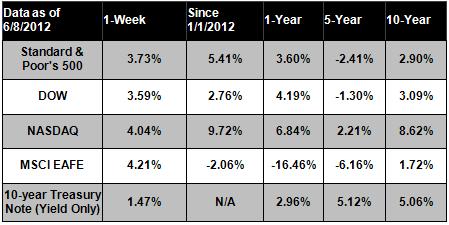
After the sustained selloff in previous trading sessions, the markets rallied Friday to claim a strong gain for the week. The S&P and Dow both booked a 0.8% gain, while the Nasdaq rose 1.0%.[1]  With the choppy market performance and gloomy economic sentiment we've seen in the past weeks, we wanted to spend some time discussing recent trends and what they might mean for the future. 
In short, many of the problems that plagued the markets in 2010 and 2011 - a serious European debt crisis and recession, a slowing Chinese economy, slow domestic growth, and the looming expiration of Bush-era tax cuts - are still with us in 2012. The uncertainty around these issues has dealt investor sentiment a major blow and spurred an exodus from equities into bonds and other "safe haven" investments, pushing Treasury yields to record lows similar to levels seen in the 2008 crisis. There's a real current of fear underlying these moves that the global economy is slipping back into recession.

Whether this fear is realized depends largely on how the credit crisis in Europe develops. Things may be looking up (at least temporarily) as Eurozone leaders have pledged to lend Spain up to 100 billion euros (approx. $125 billion) to recapitalize its banks, pending an audit this month. By pumping more liquidity into the economy, policymakers have bought themselves a bit more time to find a solution.[2]  We hope that markets will react positively to the news this week.

Domestically, many people are worrying about whether 2012 will be a repeat of the last two years, where an initially promising start fizzled out in the spring. Economic data has been patchy at best, and employment growth seems to have lost steam over the past few months, with not nearly enough jobs created to sustain continued growth. At this point, we can't be sure if this is just a temporary slowdown or a sign of continued economic contraction. Based on a number of factors, we currently suspect that this is a temporary, cyclical slowdown and that job growth will pick up in the latter half of the year. Supporting this belief, the Fed's most recent Beige Book report stated that U.S. economic growth picked up over the last two months, and hiring showed signs of a "modest increase," indicating that the situation is not as grim as many originally feared.[3]

With respect to equity markets, we know that historically, the market suffers one 10% (or greater) market correction each year. The S&P briefly touched an intraday correction of 10%, so does that mean we can expect solid growth going forward? It's impossible to know for sure, but it's rare to see the kind of persistent selling pressure that we've seen for the last month, where, for example, the Dow experienced 17 losses in 22 trading sessions. This lingering weakness has resulted in very pessimistic investor sentiment that may set markets up for a positive rebound. Additionally, we're also under the effect of typical Presidential Election year trends, which historically have called for a peak in April and a decline in June, a script the markets have followed closely this year. If the cyclical trend continues, we can expect a new burst of energy in the second half of the year.

ECONOMIC CALENDAR:
Tuesday: Import and Export Prices, Treasury Budget
Wednesday: Producer Price Index, Retail Sales, Business Inventories, EIA Petroleum Status Report
Thursday: Consumer Price Index, Jobless Claims
Friday: Empire State Mfg. Survey, Treasury International Capital, Industrial Production, Consumer Sentiment


Performance

06-11-2012 Chart

Notes: All index returns exclude reinvested dividends, and the 5-year and 10-year returns are annualized. Sources: Yahoo! Finance, MSCI Barra. Past performance is no guarantee of future results. Indices are unmanaged and cannot be invested into directly. N/A means not available.

Tuesday, June 5, 2012

Mining For Opportunities


THE MARKETS - Weekly Update - June 4, 2012

Gloomy economic data disturbed markets last week and set off alarm bells that the U.S. economy may be following Europe and Asia into a slowdown. Friday's grim jobs report showed that the economy added just 69,000 new jobs in May, far below consensus estimates, and the unemployment rate rose to 8.2% from April's 8.1%. Equity markets tumbled on the news, and the Dow showed its worst performance of the year, dropping 2.70%, while the S&P and Nasdaq lost 3.07% and 3.17%, respectively.[1]  The Dow Jones Industrial Average has now slipped into negative territory for the first time in 2012, exactly one month after closing at a multi-year high.[2]  Meanwhile, the S&P 500 is still up 1.6% year-to-date, and the Nasdaq Composite is up 5.5%.

Earlier in the week, the first quarter GDP growth estimate was revised downward to 1.9%, from the 2.2% originally reported. Although analysts had initially expected GDP growth of at least 2% in 2012, that number is beginning to look overly optimistic. Revisions to reported estimates are worth paying attention to because they can serve as leading indicators of which direction the economy is going next.[3]  The jobs data is troubling and has potential to further stall the economic recovery. Rationalizations that a warm winter artificially shifted job growth earlier in the year appear increasingly thin. The job market is simply not growing enough to ignite a robust recovery.

Thankfully, the economy is still resilient in some areas. Inflation remains reasonably low, auto sales have continued to grow, and falling energy prices are easing the strain on consumer pocketbooks, opening the door to increased consumer spending. Even so, some analysts believe that we are falling into a familiar pattern where the economy gains traction early in the year only to falter in the second quarter. With both perspectives in mind, it would be premature to predict which way things will move next. Interestingly, in 2011, the Dow's first close in negative territory for the year was on August 4th, but the year still ended with a 5.5% gain.[4]

While it's hard to dredge up the fortitude to stay invested when faced with such a slate of bad news, we haven't yet seen the effects of lowered gas prices on consumer spending, and the U.S. is still much better off than Europe. We live in a dynamic economic system; when one asset class goes down, another comes up. We can't predict the future, but we should always continue looking for opportunities!
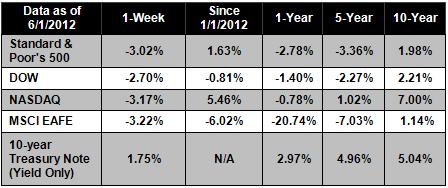
06-04 chart

Notes: All index returns exclude reinvested dividends, and the 5-year and 10-year returns are annualized.
Sources: Yahoo! Finance, MSCI Barra. Past performance is no guarantee of future results.
Indices are unmanaged and cannot be invested into directly. N/A means not available.