Monday, June 11, 2012

Markets in Flux: Weekly Update - June 11, 2012


The Markets:
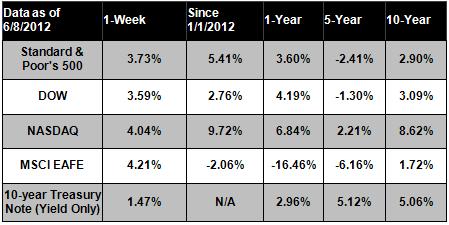
After the sustained selloff in previous trading sessions, the markets rallied Friday to claim a strong gain for the week. The S&P and Dow both booked a 0.8% gain, while the Nasdaq rose 1.0%.[1]  With the choppy market performance and gloomy economic sentiment we've seen in the past weeks, we wanted to spend some time discussing recent trends and what they might mean for the future. 
In short, many of the problems that plagued the markets in 2010 and 2011 - a serious European debt crisis and recession, a slowing Chinese economy, slow domestic growth, and the looming expiration of Bush-era tax cuts - are still with us in 2012. The uncertainty around these issues has dealt investor sentiment a major blow and spurred an exodus from equities into bonds and other "safe haven" investments, pushing Treasury yields to record lows similar to levels seen in the 2008 crisis. There's a real current of fear underlying these moves that the global economy is slipping back into recession.

Whether this fear is realized depends largely on how the credit crisis in Europe develops. Things may be looking up (at least temporarily) as Eurozone leaders have pledged to lend Spain up to 100 billion euros (approx. $125 billion) to recapitalize its banks, pending an audit this month. By pumping more liquidity into the economy, policymakers have bought themselves a bit more time to find a solution.[2]  We hope that markets will react positively to the news this week.

Domestically, many people are worrying about whether 2012 will be a repeat of the last two years, where an initially promising start fizzled out in the spring. Economic data has been patchy at best, and employment growth seems to have lost steam over the past few months, with not nearly enough jobs created to sustain continued growth. At this point, we can't be sure if this is just a temporary slowdown or a sign of continued economic contraction. Based on a number of factors, we currently suspect that this is a temporary, cyclical slowdown and that job growth will pick up in the latter half of the year. Supporting this belief, the Fed's most recent Beige Book report stated that U.S. economic growth picked up over the last two months, and hiring showed signs of a "modest increase," indicating that the situation is not as grim as many originally feared.[3]

With respect to equity markets, we know that historically, the market suffers one 10% (or greater) market correction each year. The S&P briefly touched an intraday correction of 10%, so does that mean we can expect solid growth going forward? It's impossible to know for sure, but it's rare to see the kind of persistent selling pressure that we've seen for the last month, where, for example, the Dow experienced 17 losses in 22 trading sessions. This lingering weakness has resulted in very pessimistic investor sentiment that may set markets up for a positive rebound. Additionally, we're also under the effect of typical Presidential Election year trends, which historically have called for a peak in April and a decline in June, a script the markets have followed closely this year. If the cyclical trend continues, we can expect a new burst of energy in the second half of the year.

ECONOMIC CALENDAR:
Tuesday: Import and Export Prices, Treasury Budget
Wednesday: Producer Price Index, Retail Sales, Business Inventories, EIA Petroleum Status Report
Thursday: Consumer Price Index, Jobless Claims
Friday: Empire State Mfg. Survey, Treasury International Capital, Industrial Production, Consumer Sentiment


Performance

06-11-2012 Chart

Notes: All index returns exclude reinvested dividends, and the 5-year and 10-year returns are annualized. Sources: Yahoo! Finance, MSCI Barra. Past performance is no guarantee of future results. Indices are unmanaged and cannot be invested into directly. N/A means not available.

Tuesday, June 5, 2012

Mining For Opportunities


THE MARKETS - Weekly Update - June 4, 2012

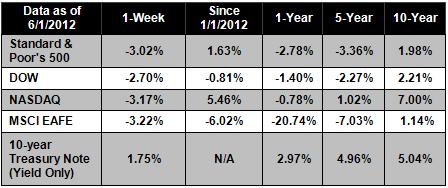
Gloomy economic data disturbed markets last week and set off alarm bells that the U.S. economy may be following Europe and Asia into a slowdown. Friday's grim jobs report showed that the economy added just 69,000 new jobs in May, far below consensus estimates, and the unemployment rate rose to 8.2% from April's 8.1%. Equity markets tumbled on the news, and the Dow showed its worst performance of the year, dropping 2.70%, while the S&P and Nasdaq lost 3.07% and 3.17%, respectively.[1]  The Dow Jones Industrial Average has now slipped into negative territory for the first time in 2012, exactly one month after closing at a multi-year high.[2]  Meanwhile, the S&P 500 is still up 1.6% year-to-date, and the Nasdaq Composite is up 5.5%.

Earlier in the week, the first quarter GDP growth estimate was revised downward to 1.9%, from the 2.2% originally reported. Although analysts had initially expected GDP growth of at least 2% in 2012, that number is beginning to look overly optimistic. Revisions to reported estimates are worth paying attention to because they can serve as leading indicators of which direction the economy is going next.[3]  The jobs data is troubling and has potential to further stall the economic recovery. Rationalizations that a warm winter artificially shifted job growth earlier in the year appear increasingly thin. The job market is simply not growing enough to ignite a robust recovery.

Thankfully, the economy is still resilient in some areas. Inflation remains reasonably low, auto sales have continued to grow, and falling energy prices are easing the strain on consumer pocketbooks, opening the door to increased consumer spending. Even so, some analysts believe that we are falling into a familiar pattern where the economy gains traction early in the year only to falter in the second quarter. With both perspectives in mind, it would be premature to predict which way things will move next. Interestingly, in 2011, the Dow's first close in negative territory for the year was on August 4th, but the year still ended with a 5.5% gain.[4]

While it's hard to dredge up the fortitude to stay invested when faced with such a slate of bad news, we haven't yet seen the effects of lowered gas prices on consumer spending, and the U.S. is still much better off than Europe. We live in a dynamic economic system; when one asset class goes down, another comes up. We can't predict the future, but we should always continue looking for opportunities!

06-04 chart

Notes: All index returns exclude reinvested dividends, and the 5-year and 10-year returns are annualized.
Sources: Yahoo! Finance, MSCI Barra. Past performance is no guarantee of future results.
Indices are unmanaged and cannot be invested into directly. N/A means not available.

Wednesday, May 30, 2012

A Hazy View


Weekly Update - May 28, 2012
The Markets:
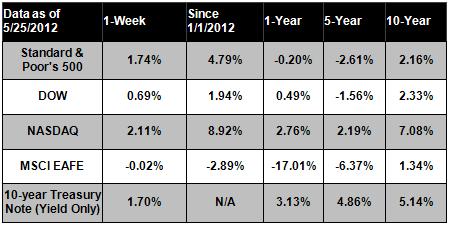
Markets started off last week with a bang and managed to hold their gains long enough to snap a three week losing streak. The S&P gained 1.74%, the Dow rose 0.69%, and the Nasdaq notched up 2.11%. Most of the action was driven by bargain-hunting traders striving to snap up deals in advance of potential rallies. Perhaps most impressive about the week's performance is that it came in the face of continued gloom from Europe.[1]  The few economic reports released last week were generally lukewarm, with unemployment flat, and home sales slightly up.[2]

Worries about Europe weren't helped by the announcement by a former Greek prime minister announcing that Greece may be considering exiting the Euro. However, European leaders are due to meet next week to discuss plans for promoting growth and preventing the recession that grips half the region from dragging down the global economy. Results of the meeting could mean a larger role for the European Central Bank or the use of controversial Eurobonds (guaranteed by the Eurozone as a whole) to bail out ailing economies.  

It'll be difficult to get a clear picture of what the next few months will bring in Europe until Greek elections on June 17 - which will define how the new government will abide (or not) by austerity agreements. As a result, the slew of U.S. economic indicators being released next week will probably feature heavily in trading. If headlines reveal that the economy is still chugging along, it should divert attention away from Europe and provide investors with incentive to jump back into equities. On the other hand, bad economic news could indicate that the Eurozone contagion is spreading and cause further declines. As always, only time will tell the story. On a side note, one silver lining in the Europe situation is the strengthening of the U.S. dollar, which could cause more money to be poured into dollar-denominated assets as investors flee a threatened euro.[3]

With the markets poised to jump whichever way the headlines blow, we strongly believe it is best for long-term investors to stick to their strategy while maintaining enough flexibility to adjust course if the situation calls for it. We pledge to keep monitoring world events as they unfold, and to keep you informed.

ECONOMIC CALENDAR:
Tuesday: S&P Case-Shiller HPI, Consumer Confidence, Dallas Fed Mfg Survey
Wednesday: Pending Home Sales Index
Thursday: ADP Employment Report, GDP, Jobless Claims, Chicago PMI, EIA Petroleum Status Report
Friday: Motor Vehicle Sales, Employment Situation, Personal Income and Outlays, ISM Mfg Index, Construction Spending
Performance

5-29-chart.JPG

Notes: All index returns exclude reinvested dividends, and the 5-year and 10-year returns are annualized. Sources: Yahoo! Finance, MSCI Barra. Past performance is no guarantee of future results. Indices are unmanaged and cannot be invested into directly. N/A means not available.
Headlines:
Durable goods orders rose 0.2% in April after a 3.7% decline the previous month. According to the Commerce Department report, gains in commercial aircraft orders and more demand for autos and parts drove the modest increase.[4]

Oil dropped below $90/barrel for the first in time seven months in trading on Wednesday as U.S. supplies continue to grow. Gasoline prices have followed the decline and dropped 26 cents since peaking in late April.[5] 

Consumer sentiment rose in May to the highest level in four years. The Thomson Reuters/University of Michigan's report claimed that higher wages and optimism about the job market helped push consumer sentiment to its highest point since October 2007.
[6]

Investors sue Facebook over pricing and trades. The commotion surrounding the tech giant's IPO should serve as a warning to investors about chasing the latest fad or hot stock.[7] 


Quote of the Week
"If your actions inspire others to dream more, learn more,
do more and become more, you are a leader".
- John Quincy Adams
Recipe of the Week
Amazing Chicken Marsala

5-29-recipie
Sage leaves and prosciutto add a luxurious touch to this weeknight dinner.
Recipe from RealSimple.com.
Ingredients:
16 fresh sage leaves
8 large, thin slices prosciutto
8 chicken cutlets
2 tablespoons all-purpose flour
1 1/2 teaspoons freshly ground black pepper
1 tablespoon olive oil
3 tablespoons butter
3/4 cup Marsala wine
2 tablespoons capers in brine, coarsely chopped
2 tablespoons chopped fresh flat-leaf parsley

Directions:
1) Heat oven to 350 degrees F. Place 2 sage leaves in the center of each slice of prosciutto, then wrap each cutlet in the prosciutto.

2) Put the flour and pepper on a plate and dredge the prepared cutlets. Heat the oil and 1 tablespoon of the butter in a large skillet over medium-high heat. Once the butter is foaming, add 4 of the cutlets, seam-side down.

3) Cook the cutlets until golden brown, about 3 minutes per side. Transfer to a baking dish. Repeat with 1 tablespoon of the butter and the remaining cutlets.

4) Transfer the baking dish to the oven and cook the cutlets for 5 minutes. Meanwhile, reduce heat under the skillet to medium-low and add the Marsala. Simmer for 3 minutes, stirring constantly and scraping up browned bits.

5) Add the capers and parsley. Stir in the remaining tablespoon of butter. Spoon the sauce over the chicken and enjoy.

Golf Tip

Clip the Tee

Many things can affect your timing (lack of practice, tension, fatigue, poor swing mechanics), but there is a good drill to help you improve it.

The idea is that if you can consistently clip a very low tee (no ball, just the tee) out of the ground with a 6 or 7 iron, you have accomplished a great deal: Your clubface is square; your swing path is straight; and there is enough speed to knock the tee out of the ground.

In addition, there is no ball to clutter your mind with results and expectations of ball flight. This frees you to focus on your setup. If you practice this drill, your timing will improve.

Healthy Lifestyle

Get Up At the Same Time Each Morning

Getting up at the same hour each morning helps you discover how much sleep your body really needs. By training your body to get up at a set time each day, you will naturally fall into a regular bedtime that corresponds to your body's need for sleep. Some days you'll need more sleep at night, so you will naturally avoid staying up too late. Your level of sleepiness should be the green light that your body needs rest.

Green Living

Inflate Your Tires

Keeping the right amount of air in your car tires may not save a significant amount of gas, but it really can cut global oil consumption. Studies prove that properly inflated ties can improve mileage by more than 3%. On a worldwide scale, that's a lot of barrels of oil. Plus, properly inflated tires are safer and last longer.

Share the Wealth of Knowledge!

Please share this market update with family, friends, or colleagues.  We love being introduced!

Investing involves risk including the potential loss of principal. No investment strategy can guarantee a profit or protect against loss in periods of declining values.

Diversification does not guarantee profit nor is it guaranteed to protect assets  The Standard & Poor's 500 (S&P 500) is an unmanaged group of securities considered to be representative of the stock market in general.

The Dow Jones Industrial Average is a price-weighted average of 30 significant stocks traded on the New York Stock Exchange and the NASDAQ. The DJIA was invented by Charles Dow back in 1896.

The MSCI EAFE Index was created by Morgan Stanley Capital International (MSCI) that serves as a benchmark of the performance in major international equity markets as represented by 21 major MSCI indexes from Europe, Australia and Southeast Asia.

The 10-year Treasury Note represents debt owed by the United States Treasury to the public. Since the U.S. Government is seen as a risk-free borrower, investors use the 10-year Treasury Note as a benchmark for the long-term bond market.

The Housing Market Index (HMI) is a weighted average of separate diffusion indices based on a monthly survey of NAHB members designed to take the pulse of the single-family housing market. Each resulting index is then seasonally adjusted and weighted to produce the HMI.

The BLS Consumer Price Indexes (CPI) produces monthly data on changes in the prices paid by urban consumers for a representative basket of goods and services. Survey responses are seasonally adjusted and weighted to produce a composite index.

The Conference Board Leading Economic Index (LEI) is a composite economic index formed by averages of several individual leading economic indicators, which are weighted to produce the complete index.

Google Finance is the source for any reference to the performance of an index between two specific periods.

Opinions expressed are subject to change without notice and are not intended as investment advice or to predict future performance.

Past performance does not guarantee future results.

You cannot invest directly in an index.

Consult your financial professional before making any investment decision.

Fixed income investments are subject to various risks including changes in interest rates, credit quality, inflation risk, market valuations, prepayments, corporate events, tax ramifications and other factors.

These are the views of Platinum Advisor Marketing Strategies, LLC, and not necessarily those of the named representative or named Broker dealer, and should not be construed as investment advice. Neither the named representative nor the named Broker dealer gives tax or legal advice. All information is believed to be from reliable sources; however, we make no representation as to its completeness or accuracy. Please consult your financial advisor for further information.

By clicking on these links, you will leave our server as they are located on another server. We have not independently verified the information available through this link. The link is provided to you as a matter of interest. Please click on the links below to leave and proceed to the selected site.

[1]  http://biz.yahoo.com/mu/update.html

[2]  http://biz.yahoo.com/mu/update.html

[3]  http://www.reuters.com/article/2012/05/26/us-usa-stocks-weekahead-idUSBRE84O15S20120526

[4]  http://www.usatoday.com/money/economy/story/2012-05-24/durable-goods/55182704/1

[5]  http://www.usatoday.com/money/industries/energy/story/2012-05-23/oil-prices-plunge/55171268/1

[6]  http://www.reuters.com/article/2012/05/25/us-usa-economy-idUSBRE84M1G420120525

[7]  http://online.wsj.com/article/SB10001424052702304707604577422063685311108.html

Wednesday, May 23, 2012

Dirty Words: Europe, Facebook


The Markets:
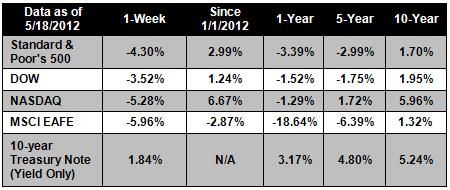
Characterized by ongoing fears about Europe and a messy Facebook IPO, last week was another rough one for the markets. The S&P fell 4.3% in five straight trading sessions, its steepest weekly decline this year, and the Dow lost 3.52%, while the Nasdaq closed down a whopping 5.28% for the week.[1]

As we approach the end of a month largely defined by selloffs, the real question to ask is: What has changed in the world since April? Last month, positive corporate earnings and upbeat economic indicators fueled market rallies. However, with earnings season behind us and domestic economic reports proving disappointing, investors have turned their attention back to Europe, worrying its crisis will spread overseas. Particularly troubling is a potential Greek exit from the Euro and a deteriorating Spanish banking system, reminding us that the sovereign debt crisis is far from over.[2]  At this point, it is probably safe to say that Europe's fiscal situation qualifies less as an isolated crisis, and more as a "new normal" - a painful situation with after effects that will be felt for years to come. Though Greece's departure from the Eurozone appears more and more likely, Europe is not on the brink of collapse. In fact, cutting Greece off from the euro faucet might actually serve as a warning to voters and politicians and encourage them to get their financial house in order. All said, Europe's currency and integrity will likely survive, but the recovery will be long.

Friday's Facebook IPO, which should have been a bright spot in a bad week was bungled by a trading software glitch and had a very tepid market debut, hovering within 0.6% of its IPO price. In reaction, investors began selling off other social media and technology stocks, pushing the technology sector down for the week.[3]

When thinking about investment strategies, rather than fretting over market forces out of our control, let's turn our attention to this "teachable moment" on the importance of diversification.* Investors who are over-exposed to Europe or who immediately jumped on the Facebook bandwagon are probably very concerned about recent market movements; however, investors who didn't put all their eggs in one basket and who are taking a long-term view, can look for value opportunities without potentially  risking their whole portfolio. This is precisely what we strive to do for our clients!

ECONOMIC CALENDAR:
Tuesday: Existing Home Sales
Wednesday: New Home Sales, EIA Petroleum Status Report
Thursday: Durable Goods Orders, Jobless Claims
Friday: Consumer Sentiment
Performance

05-21-2012 Chart

Notes: All index returns exclude reinvested dividends, and the 5-year and 10-year returns are annualized.
Sources: Yahoo! Finance, MSCI Barra. Past performance is no guarantee of future results.
Indices are unmanaged and cannot be invested into directly. N/A means not available.
Headlines:
Fitch lowers Greece credit rating. The country's credit rating was cut to CCC from B- on concerns Greece won't be able to muster the political support necessary to remain in the Eurozone.[4]

Gas prices fall ahead of Memorial Day weekend. Pump prices may fall as low as $3.25 in some parts of the country as weak demand and lower oil prices push gas prices lower. Consumers in the Pacific Northwest are experiencing high gas prices because of a temporary local gas shortage. [5]

Housing starts rose in April. According to the Commerce department, construction on new houses rose 2.6% over March, indicating the battered housing market might be improving.[6]

Leading economic index drops in April after six months of gains. The Conference Board index declined slightly in April, largely due to a drop in applications for building permits for homes and an increase in the number of people applying for unemployment benefits.[7] 

Quote of the Week
"Success is getting what you want; happiness is wanting what you get."
- Ingrid Bergman
Recipe of the Week
Chocolate Bread Pudding
05-21-2012 Recipe

Bring this fuss-free dessert to a dinner party or even a decadent brunch.
Recipe from RealSimple.com.
 
Ingredients:
4 cups milk
4 eggs
1/2 cup sugar
8 tablespoons butter or margarine
12 ounces semisweet chocolate chips
1 tablespoon vanilla extract
1 loaf white bread, crusts trimmed
1 pint heavy cream, whipped

Directions:
1) Whisk the milk, eggs, and sugar in a medium saucepan. Add the butter and chocolate and heat over low heat, stirring only until the butter and chocolate melt. Stir in the vanilla.
2) Lightly coat a 13-by-9-inch baking dish with cooking spray. Arrange the bread slices in 3 layers. Pour the chocolate sauce over the bread.
3) Cover with plastic wrap and place another baking dish on top to weigh down the bread. Set aside for 1 hour to allow the bread to absorb the sauce. (Can be made to this point up to 1 day ahead. Refrigerate.) Heat oven to 325° F.
4) Remove the top baking dish and plastic. Bake uncovered 35 to 40 minutes or until set. Serve warm with whipped cream.
5) To fake it...and save 1 hour, 10 minutes: Thaw two 13-ounce packages frozen French toast and cut into 1 ½-inch cubes. Heat oven to 325° F. Lightly coat a 13-by 9-inch baking dish with cooking spray. Place the toast in the dish. Beat 4 cups milk, one 12-ounce can chocolate syrup, and 2 eggs; pour over the toast. Cover with foil and bake 10 minutes. Remove foil and stir. Bake, uncovered, 20 to 25 minutes longer or until set. Serve warm with canned whipped cream. Total time: 50 minutes.

Golf Tip
Crooked Putters
If your putts are always crooked and you can't figure out why, it may not be your fault. Even with expensive putters, it has become relatively common for grips to be assembled improperly. If you haven't already, it is a good idea to check the grip on your putter to ensure it is not crooked. If you don't own a vice, you may need a friend to help you out. Here's how to perform the check:

Wrap a rag around the shaft of your putter and clamp it horizontally in a vice (gently, just enough to hold it). Make sure the putting face is turned upward so you can place a level on it. Once you level the putting face, place the level across the flat of the putter grip. If the bubble is not centered, your grip is crooked. Even a couple degrees will severely affect your putts, and it gets worse when the putt is long.

Healthy Lifestyle

Get a Buddy
Working out with a friend is a great way to stick with a fitness routine. Meet each other for a run in the morning or take an aerobics class after work. Just make sure you partner up with a pal you can count on to push you and help you reach your goals.
Green Living

Use Sustainable Wood in Projects

Shop carefully for the wood used in your next home project. Dimensional lumber that is larger than 2x10 usually comes from rare old-growth forests, which are disappearing from around the world. For larger lumber needs, consider engineered materials made from wood harvested from fast-growth tree species that are glued and finished. These products often perform as good as or better than hardwoods for many applications.

If your project requires solid wood, choose products with the Forest Stewardship Council label that certifies that the wood was responsibly grown and harvested. Another sustainable option is to find salvaged wood products at local used-building materials retailers.

Investing involves risk including the potential loss of principal. No investment strategy can guarantee a profit or protect against loss in periods of declining values.

*Diversification does not ensure a profit or guarantee against a loss. There is no assurance that any investment strategy will be successful. Investing involves risk and you may incur a profit or a loss.

The Standard & Poor's 500 (S&P 500) is an unmanaged group of securities considered to be representative of the stock market in general.

The Dow Jones Industrial Average is a price-weighted average of 30 significant stocks traded on the New York Stock Exchange and the NASDAQ. The DJIA was invented by Charles Dow back in 1896.

The MSCI EAFE Index was created by Morgan Stanley Capital International (MSCI) that serves as a benchmark of the performance in major international equity markets as represented by 21 major MSCI indexes from Europe, Australia and Southeast Asia.

The 10-year Treasury Note represents debt owed by the United States Treasury to the public. Since the U.S. Government is seen as a risk-free borrower, investors use the 10-year Treasury Note as a benchmark for the long-term bond market.

The Housing Market Index (HMI) is a weighted average of separate diffusion indices based on a monthly survey of NAHB members designed to take the pulse of the single-family housing market. Each resulting index is then seasonally adjusted and weighted to produce the HMI.

The BLS Consumer Price Indexes (CPI) produces monthly data on changes in the prices paid by urban consumers for a representative basket of goods and services. Survey responses are seasonally adjusted and weighted to produce a composite index.

The Conference Board Leading Economic Index (LEI) is a composite economic index formed by averages of several individual leading economic indicators, which are weighted to produce the complete index.

Google Finance is the source for any reference to the performance of an index between two specific periods.

Opinions expressed are subject to change without notice and are not intended as investment advice or to predict future performance.

Past performance does not guarantee future results.

You cannot invest directly in an index.

Consult your financial professional before making any investment decision.

Fixed income investments are subject to various risks including changes in interest rates, credit quality, inflation risk, market valuations, prepayments, corporate events, tax ramifications and other factors.

These are the views of Platinum Advisor Marketing Strategies, LLC, and not necessarily those of the named representative or named Broker dealer, and should not be construed as investment advice. Neither the named representative nor the named Broker dealer gives tax or legal advice. All information is believed to be from reliable sources; however, we make no representation as to its completeness or accuracy. Please consult your financial advisor for further information.

By clicking on these links, you will leave our server as they are located on another server. We have not independently verified the information available through this link. The link is provided to you as a matter of interest. Please click on the links below to leave and proceed to the selected site.

[1] http://uk.reuters.com/article/2012/05/18/markets-usa-stocks-close-idUKEAP10RI0F20120518
[2] http://online.wsj.com/article/SB10001424052702303505504577406353283234964.html

[3] http://uk.reuters.com/article/2012/05/18/markets-stocks-weekahead-idUKL1E8GIE0M20120518

[4] http://www.bloomberg.com/news/2012-05-17/fitch-cuts-greece-as-leaders-spar-over-euro-membership.html
 
[5] http://www.washingtonpost.com/expect-lower-gas-prices-heading-into-memorial-day/2012/05/18/gIQANE0nZU_story.html
 
[6] http://www.usatoday.com/money/economy/housing/story/2012-05-16/housing-starts-april/54990892/1
 
[7] http://www.usatoday.com/money/economy/story/2012-05-17/unemployment-claims-lei/55033942/1

Monday, May 21, 2012

A “Failed Experiment”?


Joe Nocera is a bright guy. Over the course of a lengthy career, the former Fortune executive editor has won numerous awards for excellence in business journalism and recently co-authored a penetrating analysis of the financial crisis (All the Devils Are Here: The Hidden History of the Financial Crisis). He now hangs his hat at the New York Times, covering a wide range of business-related topics.

Mr. Nocera also stands out for his willingness to discuss the sorry state of his personal finances, a startling admission for a world-class financial journalist. With his sixtieth birthday approaching, he recently revealed to readers that his 401(k) is “in tatters.” Some of the culprits are familiar: A concentrated strategy during the technology boom put a big dent in his portfolio, and a divorce several years later inflicted similar damage. A third source of difficulty is harder to fathom—the decision to raid his 401(k) to fund a home remodeling project. Such behavior strikes us as the sort of short-term thinking journalists are so quick to condemn in the executive suite. Mr. Nocera acknowledges that good financial advisors provide sound advice regarding discipline and diversification, but he doesn’t appear to have consulted one.

Mr. Nocera found a sympathetic ear in Teresa Ghilarducci, a behavioral economist at The New School. She was not the least bit surprised by his experience—most humans, in her view, have neither the skill nor the emotional stability to be successful investors. She finds the entire concept of a participant-driven 401(k) a “failed experiment.”

Prompted by this tale of woe, I dug out twenty-three years’ worth of 401(k) statements and surveyed the results for the first time. As a thirty-nine-year-old research director at LPL Financial, I was late to the starting line for the retirement race. I filled out the enrollment forms and devoted about three minutes to the task of selecting my retirement plan vehicles. When I opened my first 401(k) statement in March 1990, it showed a whopping balance of $195.26 from investments in three Putnam Equity mutual funds—two US and one global. (Mr. Nocera says he began putting retirement money away in the late 1970s, so he had at least a ten-year head start.)
After joining Dimensional in early 1995, I liquidated the Putnam funds and placed the rollover balance in Dimensional’s 401(k). I don’t recall what my thinking was at the time, but with seven equity funds in my account rather than three, it seems plausible that I devoted more than three minutes to the portfolio construction decision. Maybe six.

Over the last twenty-three years I have occasionally been tempted to fiddle with the allocation scheme, usually after some big move in the markets up or down. But I am skeptical of my capacity for self-discipline. What if a tactical decision to underweight small stocks or overweight emerging markets turned out to be right? Would I be tempted to make an even bigger bet the next time? I could find myself on a slippery slope leading to a one-fund portfolio. My preferred strategy, as a result, is to do nothing. Some might argue I have taken this slothful approach to an extreme, having never added a new fund to the lineup (no Emerging Markets Value?!), never tweaked the portfolio weights, and never rebalanced. Call it the Rip Van Winkle strategy—when you get the urge to do something, take a nap.

From a humble beginning, my account has grown to a generous sum over the past twenty-three years, although it hasn’t always been smooth sailing. Using quarterly data, the overall value fell 12.8% during the technology stock meltdown (March 31, 2000–September 30, 2002) and suffered a thumping loss of 46.8% during the financial crisis (September 30, 2007–March 31, 2009), despite a stream of fresh contributions. But the recovery was dramatic as well—up 77.5% for the twelve months ending March 2010 and up another 23.5% for the subsequent year. The current balance exceeds the 2007 high water mark by a comfortable margin. This is not an exercise in self-congratulation, just an example of what anyone could have done by harnessing the forces of competitive markets.

Perhaps the 401(k), in its current form, is indeed a “failed experiment” for a substantial fraction of the workforce. Another interpretation is that the 401(k) was never intended as a centerpiece for retirement funding, and the enrollment process cries out for improvement. Participant outcomes might be greatly enhanced if choices were presented in a way that acknowledges persistent behavioral traits leading to poor decisions.
And when it comes to charting one’s financial future, it appears even journalists skillful enough to unravel complicated financial puzzles can benefit from an objective second opinion.

Wellington, Weston. “A “Failed Experiment”?”. Dimensional Funds. 9 May. 2011.

Wednesday, May 16, 2012

Big, Bold Predictions


This sketch and post appeared originally at the New York Times on February 15, 2011.

Last fall, Malcolm Gladwell predicted that “the revolution will not be tweeted.” He took a lot of hits for this prediction, and, based on recent events in Tunisia and Egypt, it seems like it may have been inaccurate. This questionable prediction doesn’t cancel out Gladwell’s earlier work or the amazing ideas he’s shared with a wider audience.

But what this does highlight is that experts are not right 100 percent of the time. Yet we’re still held rapt by their predictions. And the bolder their calls, the more we’re interested.
Last month, I talked about gurus and their forecasts. Based on questions I heard from some readers, it might help to understand why these forecasts and predictions are so tempting.

1) It’s fun. We like having something to talk about at the neighborhood barbecue or around the proverbial water cooler. Now with Facebook and Twitter, the fun is multiplied a hundredfold. As social animals, we love being in the know and place value on being the one to break the news.

2) It’s genetic. Our natural instinct to survive makes us sensitive to the world around us, and we’re constantly trying to predict dangers lurking in the bushes. There is obvious value if you’re the person in your tribe who can successfully warn others of danger or guide them to bounty. We rely on predicting and forecasting for almost every decision we make, including the weather, our commute time and even what to wear based on what we predict others will think or say.

3) We want control. We all want to control our environment and our futures if we can. It’s very difficult to accept that much of what goes on is random and that the only constant seems to be change. In fact, I recently heard a speaker at a conference say that we’re becoming increasingly certain that the future will be uncertain. Because of the value we place on being in control, we tend to gravitate towards people we think can tell us what will happen in the future. After all, that gives us a sense of control.

4) We forget quickly. Many of the currently famous market forecasters have been wrong for years, but we quickly forget their incorrect forecasts from days gone by and cling to the one big call they recently got right. If you carefully analyze your history with market forecasters, you quickly realize that it’s a revolving door. The forecaster who appears to be a prophet today will fade into the distance and a new one will appear.

Our willingness to listen to predictions, despite research that dismantles the notion that they’re worth much, is an example of why it’s so difficult to behave correctly when it comes to our relationship with investments. It doesn’t seem to matter that these predictions are worthless. We still look for them, and genetically, we still want them. However, the best part of being human is that we can overcome genetics and recognize predictions for what they really are: a 50/50 guess.

Richards, Carl.  “Big, Bold Predictions. 15 Feb 2011. <www.behaviorgap.com>


Tuesday, May 15, 2012

Tough Problems, Tough Solutions


Weekly Update - May 14, 2012

The Markets:
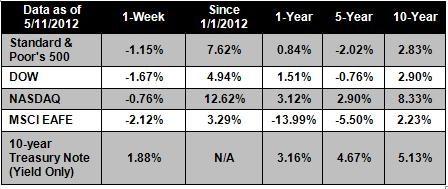
Concerns about Europe and the global economy set a negative tone last week and markets closed out at a loss. The S&P lost 1.15%, while the Dow lost 1.67%, and the Nasdaq 0.76%. On a positive note, the U.S. economy continues to slowly improve as evidenced by a surprisingly positive consumer sentiment report, showing that American consumers are still upbeat about the economy. Jobless claims held steady for the week and some analysts speculate that the unusually high unemployment claims seen in the first weeks of April were the result of seasonal adjustment and not actual job losses. Earnings season is winding down, but a few key players such as Disney, Macy's, and Kohl's posted better-than-expected earnings.[1] (These opinions are not to be construed as investment advice)

Eurozone troubles were at the core of investor concerns last week as realization dawned that in order to keep the European Union (EU) together, the European Central Bank (ECB) will have to pump trillions of euros into the monetary system. Germany is likely to face high inflation rates for the next few years as it struggles to help the economies of its partner countries. Still haunted by the hyperinflation of the early 1920s, German voters may balk at the spending required to keep the euro afloat, pressuring politicians to balance needs with voter concerns - something that is never easy to do.

The recent European elections may also make it difficult for Europe to make headway against its debt troubles. Hollande, the new Socialist president in France, has promised voters not to continue with strict austerity measures. While this is appealing to the masses, it could lead to additional downgrades on French debt, thus making problems worse. In Greece, the majority parties won less than 35% of the votes, giving significant headway to fringe parties. This development, combined with popular sentiment so opposed to necessary austerity measures, has made it increasingly likely that Greece will leave the Eurozone. While the EU can probably survive the exit of Greece, in order to preserve its integrity, it will be critical for the ECB to prevent the default (and exit) of Spain or any of the larger economies. The ECB is the only entity in Europe with the power to save Spain from default - however, the only way to do so is by printing a ton of money, and risking inflation and currency devaluation.[2]

What all this means for U.S. investors is this: The crisis in Europe is far from over, and we should not be surprised by volatility and uncertainty right now. If European politicians, nervous about losing elections, refuse to make hard budget decisions, Europe's crisis may deepen and threaten the stability of the euro. It is impossible to know what the future holds for Europe, but with every downside usually comes an upside somewhere else. We work hard to identify those upsides, and to adjust our clients' investment strategies where necessary. Thank you for the trust you've placed in us.

ECONOMIC CALENDAR:
Tuesday: Consumer Price Index, Retail Sales, Empire State Mfg. Survey, Treasury International Capital, Business Inventories, Housing Market Index
Wednesday: Housing Starts, Industrial Production, EIA Petroleum Status Report, FOMC Minutes
Thursday: Jobless Claims, Philadelphia Fed Survey

Performance

5-14 Chart

Notes: All index returns exclude reinvested dividends, and the 5-year and 10-year returns are annualized.
Sources: Yahoo! Finance, MSCI Barra. Past performance is no guarantee of future results.
Indices are unmanaged and cannot be invested into directly. N/A means not available.

Headlines:
Falling gas prices cause wholesale prices to drop in April. Wholesale gas prices tumbled to an average of $3.74 last week, nearly 20 cents cheaper than a month ago. With falling energy costs, consumers will have more money to spend on other purchases, which usually boosts the economy.[3]

Chinese industrial production slowed to 9.3% in April, down from 11.9% in March, signaling that the Asian giant may be in trouble. Analysts had predicted a jump to 12.2%.[4]

JP Morgan Chase reports $2 billion loss in derivatives portfolios. The bank, the largest in the U.S. by assets, incurred the trading loss by mishandling a portfolio of complex financial derivatives. Additional losses may occur as the bank unwinds its positions.[5]
(These opinions are not to be construed as investment advice)

U.S. records first monthly budget surplus since 2008. The federal government recorded a $59 billion surplus as tax receipts were greater than expenditures. Though this is certainly welcome news, it is unlikely to be the start of a trend.[6]


Quote of the Week
"The best way to predict the future is to create it."
- Abraham Lincoln
Recipe of the Week

Amazing Chicken Curry in a Hurry


05-14_Recipie

Perfect for a weeknight meal, this aromatic curry is both healthful and fast! Recipe from RealSimple.com.
 Ingredients:
1 cup white rice
1 1/2 tablespoons olive oil
1 small yellow onion, thinly sliced
2 teaspoons curry powder
1/2 cup plain yogurt
3/4 cup heavy cream
1/2 teaspoon kosher salt
1/4 teaspoon black pepper
1 14.5-ounce can diced tomatoes, drained (optional)
Meat from 1 rotisserie chicken, sliced or shredded
1/4 cup fresh cilantro leaves, roughly chopped

Directions:
1. Cook the rice according to the package directions.
2. Heat the oil in a skillet over medium-low heat. Add the onion and cook, stirring occasionally, for 7 minutes.
3. Sprinkle with the curry powder and cook, stirring, for 1 minute.
4. Add the yogurt, and cream and simmer gently for 3 minutes. Stir in the salt, pepper, and tomatoes (if desired). Remove from heat.
5. Divide the rice and chicken among individual bowls, spoon the sauce over the top, and sprinkle with the cilantro.

Golf Tip

Go Big or Go Home
When a clubhead is oversized, a higher percentage of its weight is moved toward the outside. Have you heard the term "perimeter weighted?" This is what it refers to.
A head that has more weight on its perimeters will tend to twist less when hit off-center. The scientific label for this is, "higher moment of inertia." Clubs with larger heads, be they woods, irons, or putters, will not twist as much when you hit them imperfectly. The result is straighter - and longer - shots. Bigger may indeed be better when it comes to clubhead size.


Make Simple Diet Changes
Most of us probably agree that we should eat a more healthful diet. However, making large changes in diet can be difficult and overwhelming when there are multiple palates to consider. Try gradually introducing a few simple changes like the following:

Eat more fruit. Adding fruit to cereal, salads, or as a meal side can add valuable vitamins while replacing high-calorie options.

Sneak in more veggies. Add them wherever you can--a tomato on your sandwich, peppers on your pizza, or extra veggies in your pasta sauce. Pre-cut veggies can also make great quick snacks.

Switch your salad dressing. If you eat full-fat dressing, switch to something lighter occasionally, or water down your full-fat dressing to eat fewer calories with each serving.

Eat low-fat or fat-free dairy. Switching to skim milk or fat-free yogurt is another simple way to eat fewer calories without having to change too much in your diet.
Healthy Lifestyle

Green Living

Seal Your Garage to Keep Hazardous Fumes Out

Garages are often full of cleaning products, pesticides, paints, and other hazardous chemicals. They also contain the combustion byproducts from car engines - including carbon monoxide. If your garage is attached to the house, keep these dangerous fumes out of your house and away from your family by ensuring that the door from the house to the garage has a tight, high-quality seal around the entire perimeter, including the threshold.